KuCoin Consensus Hong Kong 2026 Participation Benefits LiquidChain and the L3 Narrative

bitcoinist2026-02-09 tarihinde yayınlandı2026-02-09 tarihinde güncellendi

Özet

The pivot of crypto's center of gravity to Asia is accelerating, highlighted by events like Consensus Hong Kong 2026 and participation from major players like KuCoin. A key challenge in Asian markets is fragmented liquidity across major chains like Bitcoin, Ethereum, and Solana, leading to inefficiencies and risks with wrapped assets. LiquidChain ($LIQUID) emerges as a Layer 3 (L3) solution designed to unify these liquidity pools into a single execution layer, eliminating reliance on bridges and wrapped tokens. It offers a "deploy-once" model for developers to access users across all three chains seamlessly. The project’s presale has raised over $532K, with tokens priced at $0.0136, attracting early capital focused on infrastructure and interoperability. The $LIQUID token serves as transaction fuel and offers staking rewards, positioning it as a potential key player in the cross-chain narrative leading up to 2026.

The pivot of crypto’s center of gravity from West to East isn’t just a forecast anymore; it’s an active migration. With Consensus, the industry’s premier gathering, planting its flag in Hong Kong for 2025 and setting the stage for future iterations, the narrative has firmly shifted toward Asian liquidity dominance.

This momentum is further solidified by major players like KuCoin, which recently announced its participation in Consensus Hong Kong 2026. On February 12, Edwin Wong, KuCoin’s Vice President and Head of Risk Control, will join the featured panel ‘Turning Intelligence Into Action’ on the Explorations Stage to discuss how on-chain signals and AI capabilities can be translated into trust-first infrastructure and practical governance.

Hong Kong’s aggressive regulatory clarity has created a vacuum for liquidity hubs. While major exchanges figure out the licensing maze, the underlying trend is the unification of fragmented markets. Traders in the Asian session historically drive massive volume across Bitcoin, Ethereum, and increasingly, Solana. But there’s a catch: the friction of moving capital between these chains remains the industry’s glaring inefficiency.

Context matters. Bitcoin recently tested the $100K psych-level before retracing, while Ethereum struggles to maintain dominance against Solana’s monolithic speed. This ‘chain tribalism’ fractures liquidity, making execution expensive and slow. The winners of the 2026 cycle won’t be the L1s fighting for dominance. It’ll be the L3s that connect them. (It’s somewhat ironic that while users argue over which chain is ‘best,’ smart money is quietly funding the protocols that make the underlying chain irrelevant to the end-user.)

This infrastructure gap is where new interoperability layers enter the chat. As exchanges and institutions look toward the 2026 horizon, they need ‘deploy-once’ architectures. This macroeconomic setup creates a perfect storm for LiquidChain ($LIQUID), a project designed to dissolve the barriers between the industry’s three largest liquidity pools.

LiquidChain Solves the ‘Wrapped Asset’ Risk Plaguing Asian Markets

Fragmentation defines the current market structure. To trade $BTC on Solana, users rely on wrapped assets, derivatives that introduce counterparty risk and bridge vulnerability. LiquidChain flips this dynamic by operating as a Layer 3 (L3) infrastructure that fuses Bitcoin, Ethereum, and Solana liquidity into a single execution environment.

That matters for one big reason: institutional capital, the kind courted at events like Consensus Hong Kong, can’t tolerate bridge exploits. LiquidChain offers verifiable settlement without the complex user flows that currently plague DeFi. By enabling a ‘single-step execution’ model, it allows developers to build apps that access users on all three chains simultaneously.
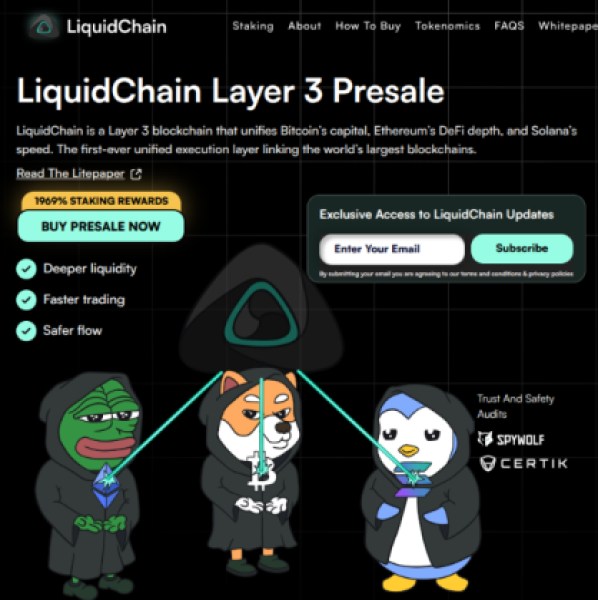
For a developer, the pitch is efficiency: deploy code once on LiquidChain, and instantly access liquidity from the top three ecosystems. No need to maintain fragmented liquidity pools across different networks, a redundancy that currently bleeds capital efficiency. As the dialogue moves toward the 2026 institutional horizon, protocols offering this level of unification are positioning themselves as the ‘TCP/IP’ of the blockchain era, invisible, essential, and highly valued.

CHECK OUT THE UNIFIED LIQUIDITY LAYER

Early Capital Flows into $LIQUID Presale Signal Infrastructure Demand

While headlines fixate on meme coin volatility, capital allocators are rotating into infrastructure plays that solve the interoperability crisis. The LiquidChain presale data reflects this methodical accumulation. It has already raised over $532K, and tokens are priced at $0.0136. Early investors also have access to staking rewards, currently sitting at 1943%.

This sub-million market cap entry point is notable compared to legacy interoperability protocols, which often trade in the billions. The pricing suggests the project is still in a discovery phase, distinct from the retail mania that usually follows major exchange listings.

The utility of the $LIQUID token extends beyond simple governance. It functions as the transaction fuel for the cross-chain VM and is required for liquidity staking. The tokenomics are designed to incentivize bonding assets from $BTC, $ETH, and $SOL into the LiquidChain ecosystem, rewarding users who provide the ‘glue’ for this unified layer. We see it as one of the next crypto to explode, due to its offering.

Investors are eyeing the $0.0136 price point not just for immediate gains, but as a derivative bet on cross-chain volume growth. If the thesis holds, that Asia will demand seamless execution across chains, LiquidChain’s ability to merge these ecosystems places it in a prime position to capture value from every transaction it facilitates.

CHECK OUT THE $LIQUID PRESALE

This article is for informational purposes only and does not constitute financial advice. Cryptocurrency investments, including presales like LiquidChain, carry high risks. Always conduct independent due diligence before participating.

İlgili Sorular

QWhat is the significance of KuCoin's participation in Consensus Hong Kong 2026?

AKuCoin's participation, with its Vice President Edwin Wong joining the 'Turning Intelligence Into Action' panel, signifies the exchange's commitment to discussing and shaping the future of trust-first infrastructure and practical governance using on-chain signals and AI, aligning with the event's focus on Asia's growing dominance in the crypto space.

QAccording to the article, what is the primary market inefficiency that LiquidChain aims to solve?

ALiquidChain aims to solve the industry's glaring inefficiency of friction and high cost when moving capital between major blockchains like Bitcoin, Ethereum, and Solana, which fractures liquidity and makes execution expensive and slow.

QHow does LiquidChain function to unify liquidity from Bitcoin, Ethereum, and Solana?

ALiquidChain operates as a Layer 3 (L3) infrastructure that fuses liquidity from Bitcoin, Ethereum, and Solana into a single execution environment, eliminating the need for wrapped assets and their associated counterparty risk by enabling verifiable settlement and a 'single-step execution' model.

QWhat are some key details about the LiquidChain ($LIQUID) presale mentioned in the article?

AThe LiquidChain presale has raised over $532,000, with tokens priced at $0.0136. Early investors have access to staking rewards, currently at 1943% APY, and the project's low market cap entry point is seen as a discovery phase distinct from typical retail mania.

QWhat is the core utility of the $LIQUID token within its ecosystem?

AThe $LIQUID token functions as the transaction fuel for the cross-chain Virtual Machine (VM), is required for liquidity staking, and is used to incentivize users to bond assets from $BTC, $ETH, and $SOL into the LiquidChain ecosystem, rewarding those who provide liquidity for the unified layer.

İlgili Okumalar

Can the Dual Currency Win Strategy Really Weather Bull and Bear Markets? A 6-Year Backtest Provides the Answer

"Can the Dual Currency Win (Wheel Strategy) truly weather bull and bear markets? A 6-year backtest (2020-2026) on Bitcoin and Ethereum provides the answer. The study compared two approaches: the 'Standard Rolling Strike' method, which dynamically sells covered calls at 105% of the current spot price, and the 'Fixed Anchor' method, which stubbornly sells calls at the original, higher cost basis after a drop, refusing to sell at a loss. Key findings reveal a significant performance gap. The Standard method, while sacrificing some upside, demonstrated superior risk-adjusted returns. For a 50/50 BTC/ETH portfolio, it achieved a +1347.32% total return with a -49.9% max drawdown and a Sharpe Ratio of 0.983, outperforming both Buy & Hold (+1665.52%, -77.8% drawdown, 0.85 Sharpe) on risk metrics and crushing the Fixed Anchor method (+592.77%, -61.8% drawdown, 0.766 Sharpe). The data shows the Standard strategy's strength lies in its dynamic adjustment mechanism, continuously resetting its strike price to balance income generation with participation in bullish trends. Conversely, the Fixed Anchor strategy's poor performance highlights the costly pitfall of the 'anchoring bias'—the human tendency to fixate on the entry price. This psychological trap cripples the ability to collect meaningful premium during bear markets and causes investors to miss subsequent bull runs when positions are called away at breakeven. The conclusion is clear: discipline and adaptability are far more valuable than the psychological comfort of 'breaking even.' The true risk in trending assets is not volatility, but being anchored to a past price, which severely limits future upside potential."

marsbit17 dk önce

Can the Dual Currency Win Strategy Really Weather Bull and Bear Markets? A 6-Year Backtest Provides the Answer

marsbit17 dk önce

İşlemler

Spot
Futures

Popüler Makaleler

L3 Nasıl Satın Alınır

HTX.com’a hoş geldiniz! Layer3 (L3) satın alma işlemlerini basit ve kullanışlı bir hâle getirdik. Adım adım açıkladığımız rehberimizi takip ederek kripto yolculuğunuza başlayın. 1. Adım: HTX Hesabınızı OluşturunHTX'te ücretsiz bir hesap açmak için e-posta adresinizi veya telefon numaranızı kullanın. Sorunsuzca kaydolun ve tüm özelliklerin kilidini açın. Hesabımı Aç2. Adım: Kripto Satın Al Bölümüne Gidin ve Ödeme Yönteminizi SeçinKredi/Banka Kartı: Visa veya Mastercard'ınızı kullanarak anında Layer3 (L3) satın alın.Bakiye: Sorunsuz bir şekilde işlem yapmak için HTX hesap bakiyenizdeki fonları kullanın.Üçüncü Taraflar: Kullanımı kolaylaştırmak için Google Pay ve Apple Pay gibi popüler ödeme yöntemlerini ekledik.P2P: HTX'teki diğer kullanıcılarla doğrudan işlem yapın.Borsa Dışı (OTC): Yatırımcılar için kişiye özel hizmetler ve rekabetçi döviz kurları sunuyoruz.3. Adım: Layer3 (L3) Varlıklarınızı SaklayınLayer3 (L3) satın aldıktan sonra HTX hesabınızda saklayın. Alternatif olarak, blok zinciri transferi yoluyla başka bir yere gönderebilir veya diğer kripto para birimlerini takas etmek için kullanabilirsiniz.4. Adım: Layer3 (L3) Varlıklarınızla İşlem YapınHTX'in spot piyasasında Layer3 (L3) ile kolayca işlemler yapın.Hesabınıza erişin, işlem çiftinizi seçin, işlemlerinizi gerçekleştirin ve gerçek zamanlı olarak izleyin. Hem yeni başlayanlar hem de deneyimli yatırımcılar için kullanıcı dostu bir deneyim sunuyoruz.

177 Toplam GörüntülenmeYayınlanma 2024.12.06Güncellenme 2025.03.21

Tartışmalar

HTX Topluluğuna hoş geldiniz. Burada, en son platform gelişmeleri hakkında bilgi sahibi olabilir ve profesyonel piyasa görüşlerine erişebilirsiniz. Kullanıcıların L3 (L3) fiyatı hakkındaki görüşleri aşağıda sunulmaktadır.

活动图片